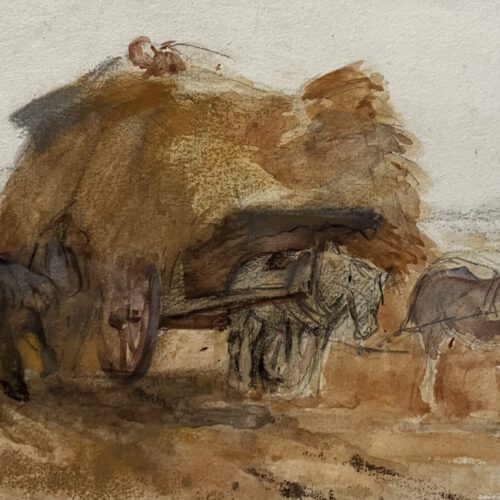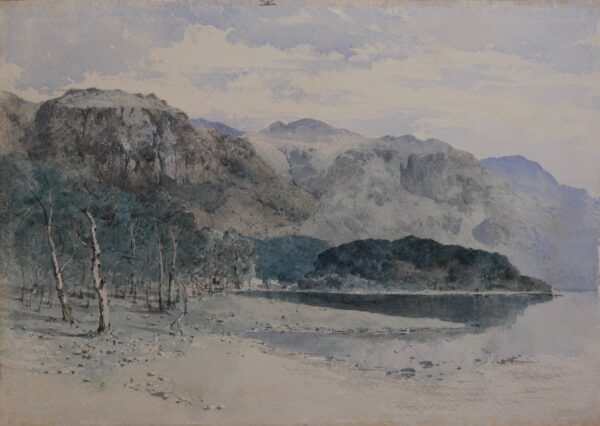
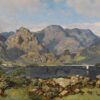

Watercolour. 8.25ins x 12ins
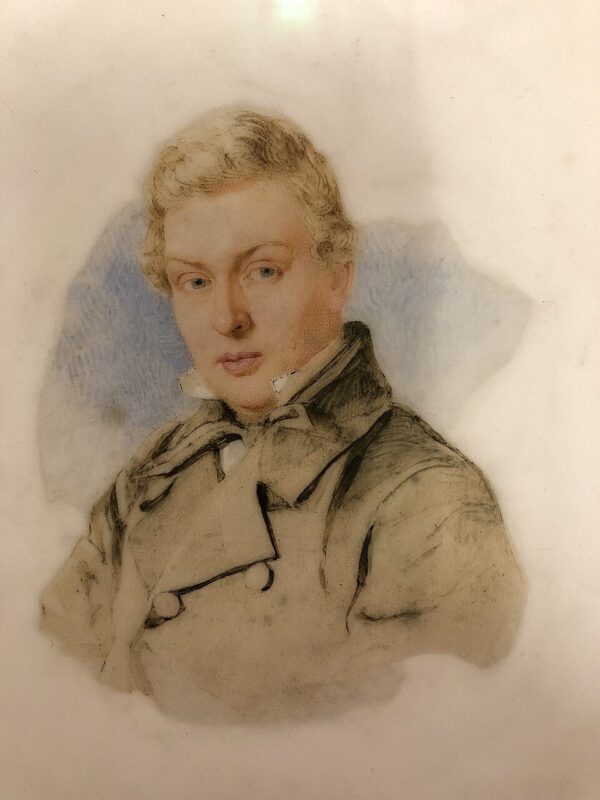
Prov. From a private collection of William James Blacklocks sold by Thomson Roddick 2020.
A very delicate , almost monochrome wash, by Blackrock.
The son of a bookseller, Blacklock worked in London for 14 years before moving back up north. He developed a pre-Raphealite style, working in oils and watercolours, exhibited rarely but was admired by David Roberts , Turner , Gladstone and Ruskin.
He gave up painting when he returned to Cumwhitton , Cumbria through ill health.
The early Pre-Raphaelite precision in Blacklock’s technique and his great power of truth was recognised by William Bell Scott and his artistic friends (almost certainly including Rossetti), who used Blacklock’s painting Barnard Castle of 1852–53 to try to study his luminous glazes over a white ground which had been developed over a number of years.
Blacklock thereafter developed into an artist of great power. The Steps at Haddon Hall, exhibited in 1848 at the Norwich Exhibition, has been described as the first thorough going mature white ground technique Pre-Raphaelite-influenced English landscape painting,[citation needed] and both its technique and inclusion of Huguenot figures, representing a thematic trend in British art of the period, as seen in John Everett Millais‘s later A Huguenot (1851–52).
Although Blacklock’s art can be described as semi-photographic, Blacklock rejected Ruskin‘s exact copying of truth to nature and the Victorian faith in facts for his own inner thoughts and imagination.
Geoffrey Grigson had written in the mid-twentieth century that “Blacklock, I reflect, belongs to the generation of Courbet, that creative wonder between Romanticism and Impressionism: he comes after Constable and after Corot,”[12] adding that Blacklock participated differently in a naturalism of vision and imagination which changed the arts by the middle of the 19th century, and was related to a broader artistic response at the time to newly valued works of the Italian Renaissance by Giorgione and Giovanni Bellini. Writing in a Sotheby’s sale catalogue in 2010, Christopher Newall noted that, “Although hard to place in the evolving pattern of progressive landscape painting in the mid-nineteenth century, Blacklock is an important and intriguing figure who may be regarded as a pivot between the early nineteenth-century landscape school and the achievements of Romanticism, and the earnest and obsessive innovation of the Pre-Raphaelite school.”[13] Blacklock’s finished oils are rare, with the largest collection of his work housed in the Tullie House Museum and Art Gallery, Carlisle, which also owns around a dozen watercolors and drawings by the artist
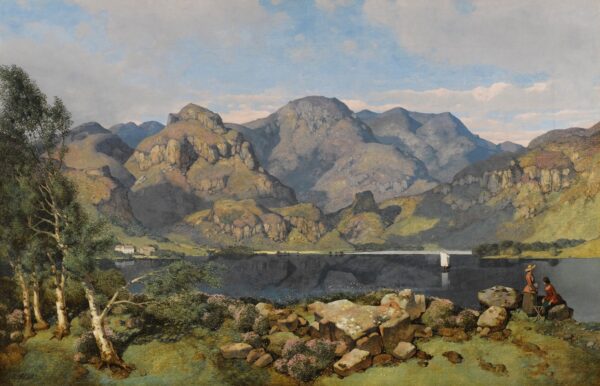
Blacklock painted several views of Derwentwater from different positions , also attached is an oil of the lake
by the artist.